
02 · Liberty
The most important cause.
Freer countries are richer, healthier, and better educated, and they take better care of the environment. The pattern is not a coincidence. It is a repeated finding.
Intro to Liberty
Liberty Q&A
- What is liberty?
Liberty is the condition in which no person, and therefore no government, may start force against your life, liberty, or property.
We all believe you should be allowed to do what you want, so long as you do not hurt people or take what is theirs. You also may not gather a group and do it together. Yet that is what government is: an organization of people that claims a monopoly on force. When a private person takes your money or hurts you, we call it a crime. When government does it, it calls the same acts taxation and law. It can compel you to act, or forbid you from acting.
- So no government?
Zero government is anarchy. That is not what I believe in. For more than 300 years, under many names, this tradition has held the same line: you do need some government. The question is how much.
At the far end, government is authoritarian or tyrannical. It piles on laws, regulations, taxes, agencies, orders, and bans. To enforce all of that, it builds a large police state, spies on its own people, and operates in secret.
If you want the most individual freedom, you want the opposite: a small, limited government, with as few laws and as little taxation as possible.
TyrannyFreedom- N. Korea3.1
- Cuba25.2
- Venezuela27.3
- Iran41.8
- China48.3
- India52.5
- Mexico59.8
- France64.6
- USA72.8
- Sweden77.8
- Switzerland83.7
Heritage Index of Economic Freedom, 2026. North Korea 3, Cuba 25, Venezuela 27, Iran 42, China 48, India 53, Mexico 60, France 65, USA 73, Sweden 78, Switzerland 84. No country in the index scores between North Korea and Cuba. Venezuela is the next one. Singapore, at 84, sits just past Switzerland. - What is the proper role of government?
The proper role of government is to protect its citizens’ natural rights: life, liberty, and property. The core duties are a military against foreign threats, a police force against domestic violence (murder, rape, assault, theft, and the like), and courts to settle criminal and civil disputes.
- But who will build the roads?
The private sector is perfectly capable of building infrastructure. Private builders laid the early American turnpikes, the railroads, the telegraph and the telephone, the electric grid, the airlines, and the cellular networks. They built the ports, the pipelines, and the broadband most people actually use.
The first benefit is that it costs the taxpayer nothing. Government projects are often corrupt, wasteful, or unnecessary. Private infrastructure is paid for by people who have to persuade investors to risk their own money. If the venture fails, citizens are not left holding the debt. If it succeeds, only the people who use it pay for it.
There is more. The owner has to maintain it, because a broken road or a dead network loses customers. It gets built sooner, because delay costs the people who put up the money. And when a better idea comes along, nobody needs a legislative session to try it.
- What about the poor?
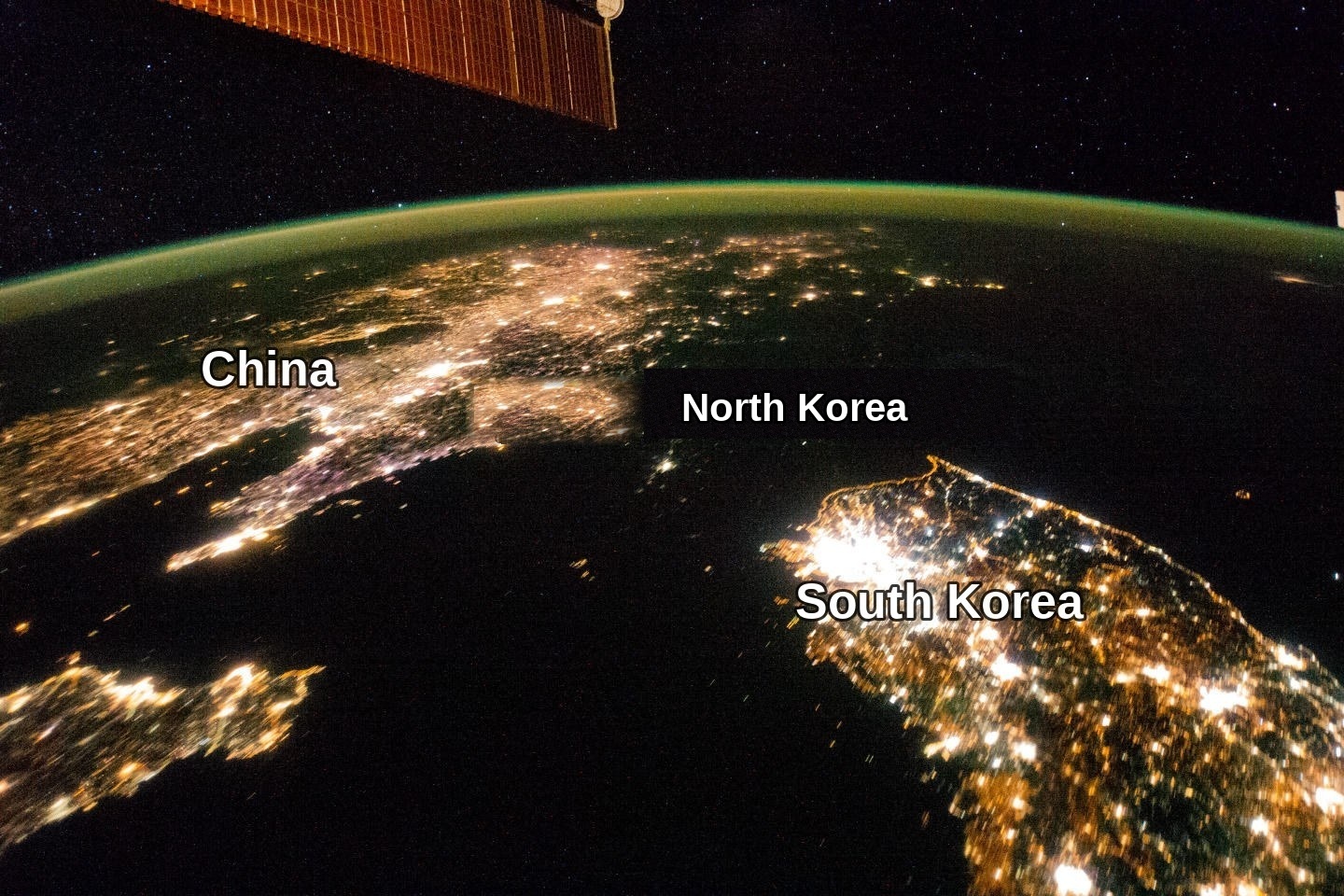
The poor get less poor where they may work, trade, and keep what they earn. Charity is a virtue because it is voluntary. In contrast, socialist ideals like government redistribution are force and have a terrible track record. Look at the night photo above, and at the chart below: repressed economies stay poor.
A rising standard of living is not a gift from a ministry. It is what happens when people are free to produce and to keep what they earn. The best thing you can do for the poor is not to manage them. It is to get out of their way, and to let neighbors help them by choice.
- What about education and health?
They follow liberty. Freer countries are healthier and better schooled because prosperity, competition, and responsibility outperform bureaucrats every time. A school or hospital that cannot fail, cannot learn.
In New Hampshire, public schools now cost about $23,000 a year per student to operate, and closer to $28,000 once buildings, buses, and debt are counted. That is more, per child, than tuition at many universities. Private options are varied, often cheaper, and parents choose them because the results fit their children better. With Education Freedom Accounts, a family can receive about $4,300 per child to start, and close to $10,000 if the child qualifies for extra aid, then pick among the options at edopt.org.
Health care has the same shape. The United States spends about $14,800 a person, nearly twice what other wealthy countries spend, and people here do not live longer because of it. Insurance and government sit between the patient and the price, so almost nobody shops and the bill climbs. Direct primary care, posted cash prices, and health sharing put the choice back with the person paying. Competition is what makes care better and cheaper.
- What is liberty not?
You will hear people claim a right to what they call “human rights,” meaning a right to someone else’s time, money, or obedience. “Freedom from want,” paid for with taxes, is not a right. It is a plan to take from one person and hand the money to another. People are forced to pay against their will. The money is often wasted, stolen, or spent on things they oppose. That is not freedom. It is force.
- Where can I learn more?
If you want to go further, start here.
- Mises Institute. Austrian economics, essays, and free books.
- Learn Liberty. Short videos and courses.
- Foundation for Economic Education. Plain-language essays on liberty.
- Libertarianism.org. A plain introduction to the ideas.
- Econlib. The Liberty Fund encyclopedia and library.
- Independent Institute. Books and research on free markets and civil liberties.
- Fraser Institute. Economic freedom rankings, including North America.
The data
The Economic Freedom Index and the Human Development Index move together.
The Heritage Foundation’s Index of Economic Freedom scores 176 countries on property rights, tax burden, regulation, trade, and the rule of law. The 2026 Index finds the same pattern it has found for decades: freer countries are richer, healthier, and better educated. Heritage’s series correlates about 0.71 with the UN Human Development Index, indicating a strong positive relationship between the two.
Economic freedom creates the conditions in which people can build wealth, innovate, and improve their lives.
People in free and mostly-free economies earn several times what people in repressed ones do. Singapore, Switzerland, and Ireland sit at the top. Venezuela, Cuba, and North Korea sit at the bottom. The chart below plots every country scored in both indexes.
Every country in both indexes
Heritage Index of Economic Freedom 2026 (x) against the UN Human Development Index 2023 (y). 173 countries. Correlation in this plot is 0.71. The dashed line is the least-squares fit.
- Free (80+)
- Mostly free
- Moderately free
- Mostly unfree
- Repressed
- Trend
Heritage Foundation, 2026 Index of Economic Freedom; UNDP Human Development Report 2025 (HDI values for 2023). Three Heritage-scored countries (Taiwan, Kosovo, North Korea) have no UNDP HDI and are omitted.
This is not an American talking point. It is a cross-country fact. I saw the low-freedom end up close. On the Fraser Institute’s North American index, Puerto Rico ranks 61st, placing below every U.S. state and Canadian province and just above the highest-ranked Mexican states. And guess what. Puerto Rico has a lower standard of living than all U.S. and Canadian states, but higher than Mexico. This is not a coincidence.
Heritage Index of Economic Freedom · UN Human Development Index
I'll write you
I use your name, email, and zip only to write you. I do not sell them.
Follow @serrapedro